Tuesday, 30 August 2022

DMIC Maths 2022. Term 2

 Number: Fractions

Tupou says that she can write more than 20 numbers between 0 and 1. Hemi says that there are none, so Tupou writes them and uses a number line to prove that they exist. Can you write some numbers you think Tupou wrote and show where you think she marked them on her number line?


What are all the different ways you can use fraction tiles to make one whole? As you make these, record them, and be ready to explain and justify how they make one whole. 

What are all the different ways you can use the fraction tiles to make a fraction number that is less than one-half but more than two twelfths? As you make these, record them, and be ready to explain and justify why they are less than one whole.

What are all the different ways you can use the fraction tiles to make a fraction number that is more than one whole but less than one and 1 quarter? As you make these, record them, and be ready to explain and justify why they are more than one whole.


What are all the different ways you can use the fraction tiles to make a fraction number that is less than one-half but more than one-quarter? As you make these, record them, and be ready to explain and justify why they are less than one-half.


What are all the different ways you can use the fraction tiles to make a fraction number that is between two-thirds and seven eighths? As you make these, record them and be ready to explain and justify why they are between one half and one whole.


What are all the different ways you can use the fraction tiles to make a fraction number that is more than one whole and less than one and a third? As you make these, record them and be ready to explain and justify why they are more than one whole and less than 2.


What are all the different ways you can use the fraction tiles to make fraction numbers that are the same as one-fifth?


What are all the different ways you can use the fraction tiles to make fraction numbers that are the same as one-eighth?


Statistics

Melvin and Khaleesi help their parents at home with the chores. They wonder how much time other tamariki at their school spend helping their whanau with chores. Here is the results they collected showing how many minutes a group of tamariki in the school spend doing chores on the weekend.

15  23  8  12  25  65  0  20  15  21  30 0  28   10 25  21  18  22  25  32  5   35  26  20  25  30  16  24  25  10  15

Can you put the data into a stem and leaf graph? Make “I wonder” and, “I notice” statements about the data.


Mereana is the goal shooter for the netball team. She decided to work out her statistics for goal shooting. Over 8 games, her mean score was 5, the median was 6, and the mode was 4. What might her scores be for each game?


The average (mean) temperature over a week was 20 degrees Celsius. The highest temperature was 25 degrees Celsius. What might the temperature have been on the other days? Draw a table to show the time-series data. Represent the time-series data using a line graph. Make statements about the temperature over the week.


The mean is 10. The median is 12. The data set has 16 numbers. What might the numbers be? Develop a story about the data set and the question that it might be answering. Represent your data set and write statements about it.


DMIC Maths 2022. Term 1.

  Measurement: Mass, volume, and capacity

For Maia’s birthday party her family ordered small bottles of mixed soft drinks. Each bottle contained635ml of drink. They bought 60 bottles but only 47 bottles were used. How much in liters and milliliters was used? How much in liters and milliliters was left?

This weekend our church had a special children’s celebration for White Sunday. TJ and his friends had to mix the orange juice for lunch. He had two recipes for mixing the orange juice. They were told to make the none with the most orange taste because most children preferred that. Recipe 1: Mix 2l orange to 3l water Recipe 2: Mix 3l orange to 5l water Which recipe did they use?


Ta’ase is sending a parcel to her family overseas. She needs a box with a volume of 10 000 cm3. Find the volume of the boxes to see if they are big enough.


Given global warming and Covid-19, schools need air conditioners with air filters that match the classroom's volume. What is the volume of your classroom? As part of your explanation, draw a representation to use to explain and justify your solution.


Find two containers that have the same capacity, and will hold more than a liter but are of different shapes. Prove that they have the same or almost the same capacity. Record the capacity of each container using mL and l. Make sure that you explain and justify your reasoning using a range of representations I including a number line.


Number and Algebra


Moana is playing Monopoly with her friends. She had $235 in monopoly money. After she had bought two properties, she had only $119 in monopoly money left. How much did she spend to buy the two properties?


Moana is playing Monopoly with her friends. She had $1327 in monopoly money. After she had bought five properties, she had only $158 in monopoly money left. How much did she spend to buy the five properties?


Mere and Hurae are playing the Game of Life. Hurae wins the golden lottery and now has $7442. Before he won the golden lottery, he had $2789. How much money did he win?


Mere and Hurae are playing the Game of Life. Hurae wins the golden lottery and now has $5432. Before he won the golden lottery, he had $4785. How much money did he win?

Junior’s mum needs to order tipani flowers to make ‘ei katu for his sister’s wedding. There are 19 people at the bridal party and each ‘ei katu needs 26 tipani flowers. How many flowers will Junior’s mum need to order?

Wednesday, 10 August 2022

Inquiry, Term 3, 2022

 Sharing My Learning


Background: New Zealand Wars. There were many wars in New Zealand. Some of these wars were; the Northern war, 1845–1846, Wellington and Whanganui wars, 1846–1848, North Taranaki war, 1860–1861, Waikato war: beginnings, Waikato war: major battles, and Gate Pā, Tauranga. New Zealand went to war in Turkey at Gallipoli. Today, The war at Gallipoli is known as ANZAC and an annual celebration takes place to commemorate the fallen soldiers and the return of service men and women. This unit plan is derived from the war at Gallipoli. The life of the New Zealand men and women who were fighting the Turkish prompted us to develop our unit plan for teaching and learning.


Previous Experiences: Our Inquiry Topic is ‘Me The Wayfinder’. In term one, the students researched and studied the unit plan lessons about ‘me, the learner’. In term two, students researched and studied the unit plan lessons about ‘Filling my kete’. The term 2 unit plan focused on the ANZAC war. Students researched the history of the ANZAC war and Life In The Trenches. These two focus areas formed the term two unit plan. Students discovered that” Individuals spent only a few days a month in a front-line trench. Daily life here was a mixture of routine and boredom – sentry duty, kit, and rifle inspections, and work assignments filling sandbags, repairing trenches, pumping out flooded sections, and digging latrines. Any free time was usually spent reading or writing letters or diaries, playing cards or trying to snatch a few moments of sleep”. Therefore to understand life in trenches better, students made three-dimensional models of trenches. They used materials that were available at no cost in the classroom and the cardboard borrowed from our school’s resource center.


Broad Understanding/s: (Teacher Directed) 

That the students can play a part in learning to be innovative developers

of products and systems

That the students can explain how the use of technology can help in making life easier in performing the tasks for which the technological design is intended.


Learning Question/s: While doing the research on ‘Life in the Trenches' students discovered that soldiers suffered from a long period of boredom, ‘Daily life here was a mixture of routine and boredom.

This information prompted the students to think about the question; ‘ What could have we done for our soldiers so that they could have occupied their time in a better way?’ Many ideas were proposed by the students to solve the problem
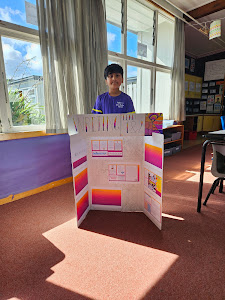
of boredom. One of the solutions that seemed very promising to the students was to make a ‘ Gutter ball board’ for the soldiers. Students generally admitted that soldiers can play Gutter ball board to pass time and keep their minds off the matters that made them stress out and cause depression.  Hence, the students have decided to make a Gutter ball board this term because the idea is innovative and creative.


Key Competencies: (This is an opportunity to link the key competencies to the student's

learning in

Technology – this is not for assessment purposes.) The students had

been exposed to the key competencies in the past and had input

into this planning.

The teacher and the students revisited the concepts often to make sure

that we were on track


Thinking: 

Thinking about how we will gather the information required to answer

our learning question.

Learners identify the different structures around them and their intended

purposes.

Thinking about how to solve problems associated with feeling bored,

stressed, feeling low and down, helpless and depressed.


Using language, symbols, and texts:

Understand the mathematical symbols such as mm and cm. Ability to

use the conversion factor used in measurements.

Understand the symbol used to represent angles such as ∠ for angle,

∟ for right angle 

Use the language of technology to enhance understanding of

technology.


Managing self: 

Utilize the time given to this unit of work effectively. 

Work independently when required. 

Understand the constraints of the work and how to be economic with

resources.


Relating to others: 

Work collaboratively and cooperatively in groups when required. 

Brainstorming of ideas together.

Learning through experts.

https://www.youtube.com/watch?v=q3K-U8JU0h4 watch for step-by-step making Gutter ball board.

Use the internet to gain information:

https://www.kiwifamilies.co.nz/articles/make-gutter-board/ for How to Make a Gutter Board Game. 


Participating and contributing: 

Students understand that they can be valuable members of the

community and help others in the society and wider whanau group.

Students understand that they can make a difference by developing

a the solution that helps others to solve problems.


Values: Why Throwing and Catching Games are Great for Kids

Development?

Small ball skills are awesome for teaching children a whole range of

motor skills and brain development. Kid Activities says a whole range

of skills is improved by playing throwing games. They list these

4 broad kid’s development areas that throwing and catching

games improve:

Improves hand-eye coordination. Developing good hand-eye

coordination is an essential part of a child’s development. It allows

a child to direct and control their limbs, making it possible to

interact with objects in the physical world more easily.

Improves fine motor skills. Fine motor skills is the coordination

of small muscles, like those in the fingers and hands, with the eyes.

Developing fine motor skills gives children the dexterity necessary

to perform complex tasks like picking up and arranging small objects.

Improves gross motor skills. Gross motor skills involve whole body

movement and the engagement of larger muscles like those in the core.

Developing gross motor skills is essential for performing everyday t

asks like standing, walking, running, and jumping.

Improves timing and prediction. Many children struggle with
timing when they are learning to throw and catch balls.
Throwing games will help them quickly develop this skill.
They also learn the physical characteristics of balls, developing
an understanding of how they bounce and roll.


How to Make a Gutter Board Game?

 We will need:

1 x 1200mm long 150x40mm timber fence rail, or 150x20mm fence paling (ideally treated to H3.2)

3 x 75mm stainless steel self-taping decking screws

Sandpaper

Resene Quick-dry Primer

Resene test pots in Yowza, FX Fluoro Pink, and Funtasia

Paintbrush

A saucer, round plant pot, and a test-pot lid to trace around

Paper cups or jars to mix up paint


Youtube link

Watch the making of a Gutter ball board by clicking this link: https://www.youtube.com/watch?v=q3K-U8JU0h4

Thursday, 31 March 2022

Handwriting

 Handwriting


Practicing handwriting is very important so that we as writers can form our letters automatically. This means we do it without thinking about how to form the letter, just like driving we do not think about how to put the brake on, we just do it.


It is important that they start in the correct place and go in the right direction. Ideally, a child should form their letters fluently so it is important they keep practicing a letter until they can form it correctly and quickly without too much thinking about how to do it.


HANDWRITING GOALS

1. All upper case letters touch the top and bottom of the line.

 2. All lower case letters are half size and sit on the bottom line. 

3. All letters should be formed correctly and be an even and consistent size. 

4. All numbers are 3/4 size. They sit on the bottom line. 

5. The lower case ‘t’ is 3/4 size. It sits on the bottom line but doesn't touch the top line. 

6. The upper case ‘M’ touches the top and bottom line and the middle point touches the bottom line. 

7 The upper case ‘W’ touches the top and bottom line and the middle point touches the top line., 

8. The lower case ‘k’ is the loopy one. 

9. The upper case ‘Y’ is point one. 

10. Letters with tails must sit on the bottom line and the tails drop halfway down into the line below


Resources

http://nzteachersprimary.weebly.com/uploads/1/0/5/0/10506400/handwriting_goals_checklist.pdf


Inquiry

 Celebrating My Learning. "Celebrating My Learning" could refer to recognizing and acknowledging personal achievements and growth ...